






Loading tools... Please wait.
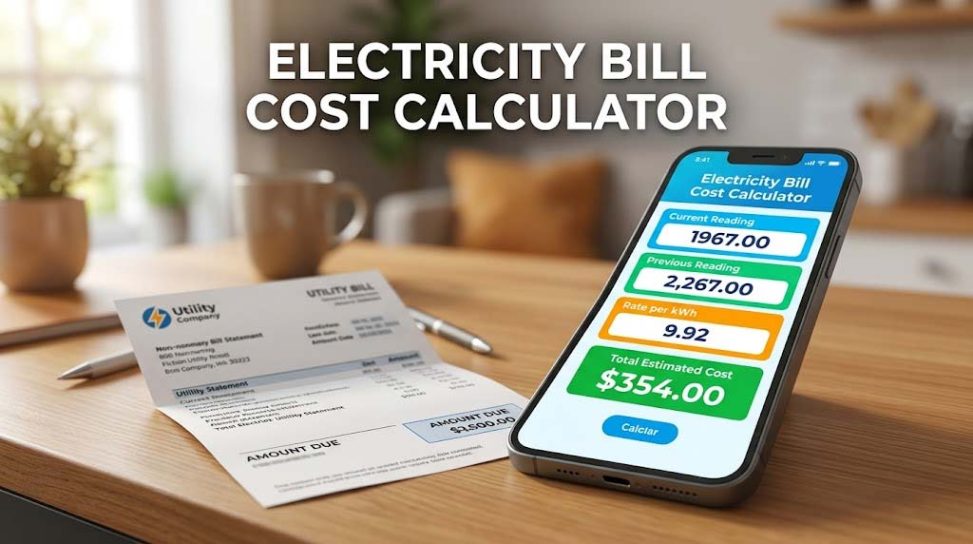
An Electricity Bill Cost Calculator is a useful online tool for estimating the cost of electricity based on energy consumption and the applicable electricity rate. It can help homeowners, tenants, businesses, and students understand how electricity usage affects monthly expenses. By entering estimated usage and a price per kilowatt-hour, users can quickly calculate an approximate electricity cost.
What Is an Electricity Bill Cost Calculator?
An electricity bill calculator estimates how much you may need to pay for a specific amount of electricity consumption. Electricity usage is commonly measured in kilowatt-hours (kWh), while the price is often calculated according to the applicable tariff. A calculator combines these values to provide a simple cost estimate.
How Does an Electricity Cost Calculator Work?
The basic calculation starts with electricity consumption measured in kilowatt-hours. This amount is multiplied by the applicable electricity rate per kWh. A simple estimate can therefore be expressed as Electricity Cost = Energy Consumption × Electricity Rate.
Key Benefits of Using the Calculator
- Quick estimates: Calculate potential electricity costs without complicated mathematics.
- Budget planning: Estimate monthly energy expenses in advance.
- Usage awareness: Understand how electricity consumption affects your bill.
- Appliance comparison: Estimate the energy cost of different electrical devices.
- Energy management: Identify opportunities to reduce unnecessary consumption.
Understanding Kilowatt-Hours
A kilowatt-hour is a unit of energy commonly used for electricity billing. One kilowatt-hour represents the energy used by a 1-kilowatt device operating continuously for one hour. For example, a 1,000-watt appliance running for one hour uses approximately 1 kWh.
| Appliance | Example Power | Usage Time | Approximate Energy Use |
|---|---|---|---|
| LED Light | 10 W | 5 hours/day | 0.05 kWh/day |
| Ceiling Fan | 70 W | 8 hours/day | 0.56 kWh/day |
| Refrigerator | 150 W | 8 equivalent hours/day | 1.20 kWh/day |
| Air Conditioner | 1,200 W | 6 hours/day | 7.20 kWh/day |
These figures are examples only. Actual appliance consumption can vary depending on efficiency, operating conditions, settings, and usage patterns.
Basic Electricity Cost Formula
To estimate the cost of an appliance or electrical system, first determine its power consumption and operating time. Convert watts into kilowatts, multiply by the number of operating hours, and then multiply the resulting kWh by the electricity rate.
Energy Used (kWh) = Power (kW) × Time (hours)
Estimated Cost = Energy Used (kWh) × Electricity Rate
Estimating Appliance Electricity Costs
Understanding individual appliance consumption can help explain why electricity bills change from month to month. High-power devices such as air conditioners, electric heaters, water heaters, ovens, and pumps can consume considerably more energy than small electronic devices. Estimating their usage can help you identify the biggest contributors to your bill.
Factors That Affect an Electricity Bill
Your final electricity bill may involve more than a simple energy-consumption calculation. Electricity tariffs, fixed charges, taxes, service fees, demand charges, tiered pricing, and other local billing rules can affect the amount payable. Therefore, an online calculator may provide an estimate rather than an exact copy of your utility bill.
Understanding Tiered Electricity Rates
Some electricity providers use different rates for different levels of consumption. Under a tiered structure, the price per unit may change when consumption reaches a particular threshold. If your local utility uses tiered pricing, an accurate calculator should account for the relevant tariff structure rather than applying one rate to all electricity usage.
Electricity Usage and Energy Efficiency
Reducing electricity consumption does not always require major lifestyle changes. Switching to efficient appliances, turning off unnecessary equipment, improving cooling efficiency, and avoiding standby consumption can all contribute to lower energy use. Monitoring your consumption regularly can make these savings easier to identify.
Electricity Costs for Businesses
For businesses, electricity can be a significant operating expense. Offices, restaurants, retail stores, workshops, and production facilities may use electricity for lighting, cooling, computers, machinery, refrigeration, and other equipment. A calculator can provide a quick estimate that supports basic energy budgeting.
Using Digital Tools for Business Planning
Digital tools can simplify many business tasks, including financial calculations, content creation, product management, and data organization. People working in creative industries can also benefit from specialized training. For example, Cake Decorating Courses Online With Certificate can help learners develop practical skills for a creative food business or personal project.
Electricity and Product Photography
Electricity costs can also be relevant to creative professionals who operate studios or product photography setups. Continuous lighting, computers, monitors, charging equipment, and other studio devices can contribute to overall energy consumption. Understanding operating costs can help freelancers and small businesses price their services more effectively.
Anyone interested in improving commercial product images can explore a Product Photography Course Online Free. Better product presentation can be particularly valuable for online stores and small businesses.
Using Excel to Track Electricity Costs
Spreadsheets are useful for recording monthly electricity consumption and comparing bills over time. You can create columns for billing dates, kWh usage, electricity rates, additional charges, and total costs. This makes it easier to identify seasonal trends and unusual increases in consumption.
An Excel Advanced Course Free With Certificate can help users develop spreadsheet skills for calculations, data organization, reporting, and business analysis.
Comparing Monthly Electricity Consumption
Looking at only one electricity bill may not provide enough information to understand your normal usage. Comparing several months can reveal whether consumption increases during hot or cold seasons or after adding new appliances. A simple spreadsheet or calculator can make these comparisons easier.
Common Electricity Calculation Mistakes
- Confusing watts with kilowatts.
- Forgetting to account for the number of operating hours.
- Assuming every appliance consumes its maximum rated power continuously.
- Using an outdated electricity rate.
- Ignoring additional charges or tiered pricing.
- Assuming an online estimate will exactly match the utility bill.
How to Use an Electricity Bill Cost Calculator
- Determine your electricity consumption in kWh.
- Check the applicable electricity rate.
- Enter the consumption and rate into the calculator.
- Review the estimated energy cost.
- Add applicable fixed charges, taxes, or other fees if required.
- Compare the estimate with your actual electricity bill.
Using the Calculator for Energy Planning
An electricity cost calculator can also be useful before purchasing a new appliance. If you know the appliance’s power rating and expected daily usage, you can estimate its potential contribution to your monthly electricity consumption. This allows you to consider operating cost alongside the purchase price.
How to Reduce Electricity Costs
- Use energy-efficient lighting and appliances.
- Switch off devices when they are not needed.
- Reduce unnecessary air-conditioning usage.
- Keep cooling equipment clean and properly maintained.
- Monitor high-consumption appliances regularly.
- Compare monthly electricity usage to identify unusual increases.
Why Accurate Data Matters
The quality of a calculator’s result depends on the information entered. Using the correct appliance wattage, realistic operating hours, and current electricity rates can make the estimate more useful. When planning a large commercial or residential energy system, professional energy assessment may provide more accurate results.
Final Thoughts
An Electricity Bill Cost Calculator provides a simple way to estimate energy expenses and understand the relationship between electricity usage and cost. It can help households, businesses, students, and professionals plan budgets, compare appliance usage, and identify opportunities for better energy management. Since actual bills may include tariffs, taxes, fixed charges, and other factors, use calculator results as an estimate and verify important figures against your local electricity provider’s billing information.
Leave a Reply