








Loading tools... Please wait.
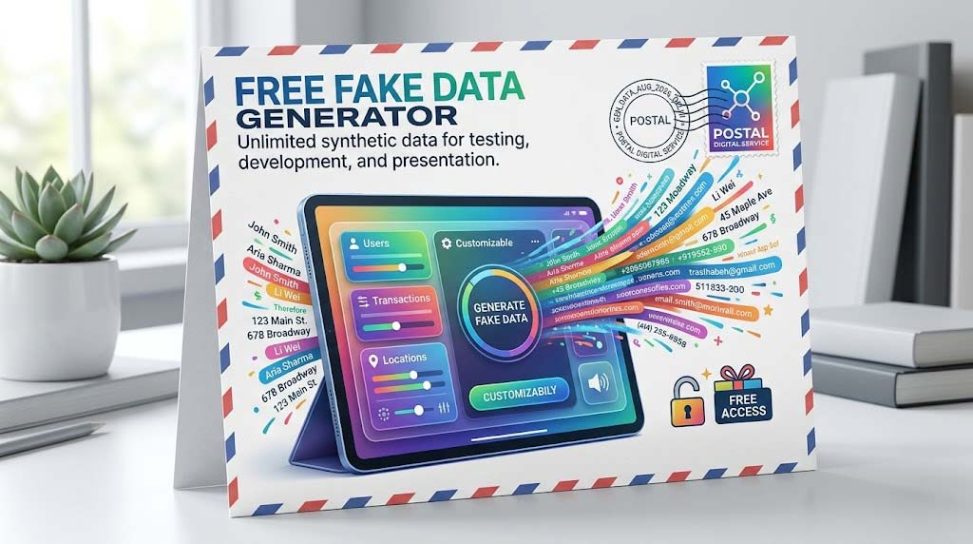
A Free Fake Data Generator is a useful tool for developers, designers, testers, students, and data professionals who need sample information without creating every record manually. Whether you are testing a database, building a web application, preparing a demo, or designing a data table, realistic-looking dummy data can make the development process faster and easier.
What Is a Fake Data Generator?
A fake data generator is a tool that creates artificial or sample information based on predefined data types. Depending on the tool, it may generate names, email addresses, phone numbers, addresses, dates, numbers, usernames, company information, and other common fields.
The generated information is intended for testing, development, demonstrations, and other non-production purposes. It should not be confused with real customer or personal information.
Why Use a Free Fake Data Generator?
- Saves Time: Create many sample records without entering them manually.
- Improves Testing: Test applications with different types and amounts of data.
- Protects Privacy: Use artificial information instead of real personal records.
- Supports Prototyping: Populate designs and interfaces before real data is available.
- Useful for Learning: Practice database and programming tasks with sample information.
- Easy Demonstrations: Prepare realistic-looking datasets for presentations and demos.
Types of Fake Data You Can Generate
Different projects require different kinds of sample information. A versatile fake data generator may provide several categories so users can create datasets that closely match their project requirements.
| Data Type | Example Use |
|---|---|
| Name | User and customer testing |
| Registration and email-form testing | |
| Phone Number | Contact form testing |
| Address | Shipping and location interfaces |
| Date | Reports and scheduling systems |
| Number | Statistics and calculations |
| Username | Login and profile interfaces |
| Company | Business application testing |
Fake Data for Website Development
Web developers often need sample content while building websites and web applications. A fake data generator can quickly populate registration pages, dashboards, customer lists, product tables, and profile screens.
This is especially helpful when the database has not yet been connected to a live backend. Developers can work with sample records while designing the front-end experience.
Fake Data for Database Testing
Databases often need to be tested with multiple records rather than just one or two examples. Manually creating hundreds or thousands of records can take considerable time.
Generated data can help developers test sorting, filtering, pagination, searching, relationships, validation rules, and database performance. However, the structure of the generated data should match the database schema to produce meaningful results.
Fake Data for API Testing
APIs frequently return structured information such as users, products, orders, transactions, or articles. During development, an API may not yet have enough records to test every possible interface condition.
Sample datasets can provide the variety needed to test API requests and responses. Developers can also use generated records to check how applications behave when receiving empty, large, repeated, or unusual datasets.
Using Fake Data With JSON
JSON is one of the most common formats for exchanging structured information between modern applications. Generated data can therefore be especially useful when creating JSON-based test datasets.
After generating or preparing sample JSON, you can use a Free JSON Formatter Online to format the structure into a more readable layout. This makes nested objects, arrays, and individual properties easier to inspect.
Fake Data and JSON Arrays
When creating multiple records, JSON arrays provide a convenient structure for representing collections of objects. For example, a list of sample users can contain multiple user objects within a single array.
This structure is useful for testing user directories, dashboards, search results, product listings, and other interfaces that display multiple records at once.
Fake Data for UI and UX Design
Designers often need realistic content to understand how a user interface will look with actual information. Empty layouts may not reveal problems caused by long names, large numbers, lengthy addresses, or different content lengths.
Sample data helps designers test tables, cards, forms, dashboards, profile pages, and responsive layouts before real information becomes available.
Testing Responsive Web Interfaces
Data-heavy interfaces must work across desktops, tablets, and mobile devices. Long names, addresses, numbers, and table columns can create layout problems on smaller screens.
A Responsive CSS Breakpoint Generator can help developers determine suitable CSS breakpoints when building interfaces that display generated datasets.
Testing with varied sample information is important because a layout that looks perfect with short placeholder text may break when realistic content is inserted.
Fake Data for Dashboard Development
Business dashboards often contain charts, tables, statistics, customer records, and activity reports. During early development, real business data may be unavailable or inappropriate to use.
Artificial datasets allow developers to populate these components and test how the dashboard behaves. This also makes it easier to demonstrate an unfinished project to stakeholders without exposing confidential information.
Fake Data for Software Testing
Software testing requires applications to handle many different input conditions. Sample information can help testers check whether forms, search systems, filters, databases, and validation processes behave correctly.
For example, a registration form can be tested using different names, email formats, phone numbers, dates, and usernames. This can reveal interface and validation issues before the application reaches production.
Fake Data and Privacy
One of the important advantages of artificial data is that it can reduce the need to expose real personal information during development. Real customer records may contain names, contact details, addresses, or other private information.
Using fictional information during development and demonstrations can therefore be a safer approach. Generated data should still be clearly identified as test data and should not accidentally be presented as real customer information.
Realistic Data vs Random Data
Good testing data does not always need to look completely random. In many situations, realistic patterns are more useful because they resemble the information an application will encounter in real-world use.
| Data Approach | Useful For |
|---|---|
| Random Data | Basic input and volume testing |
| Realistic Data | UI, workflow, and application testing |
| Boundary Data | Validation and error testing |
| Large Dataset | Performance and pagination testing |
Testing Large Datasets
Applications can behave differently when they contain a few records compared with thousands of records. Large fake datasets can help developers identify slow database queries, inefficient rendering, pagination problems, and other performance issues.
When performance testing is the goal, the generated dataset should be sufficiently large and representative of the expected production workload.
Fake Data for Excel and CSV Workflows
Sample data is also useful outside web development. Students, analysts, and business users can generate fictional records for practicing spreadsheets, filtering, sorting, pivot tables, formulas, and reporting.
For example, a fictional sales dataset can be used to practice calculating totals, comparing monthly performance, or creating charts without requiring access to confidential business information.
Fake Data for Learning Programming
Beginners can use generated data while learning programming concepts such as loops, arrays, objects, sorting, filtering, searching, and database queries. Having a larger dataset makes programming exercises more realistic.
Instead of manually writing dozens of records, students can generate sample information and focus on understanding how their code processes it.
Creating a Modern Fake Data Tool Interface
If you are developing your own fake data generator, the interface should make data selection and output management simple. Useful controls may include field selection, record count, data type selection, formatting options, and copy or export functionality.
A clean interface can also use visual elements to separate input controls from generated results. If you want to experiment with a modern translucent visual style, a CSS Glassmorphism Background Generator can help create glass-style backgrounds for web interfaces.
Important Features of a Good Fake Data Generator
- Multiple Data Types: Support common fields such as names, emails, dates, and numbers.
- Custom Record Count: Allow users to generate the amount of data they need.
- Easy Output: Present generated information in a readable format.
- Structured Formats: Support formats such as JSON, CSV, or table-based output where appropriate.
- Fast Generation: Generate datasets without unnecessary processing.
- Privacy-Friendly: Avoid using actual personal information as sample data.
Common Mistakes When Using Fake Data
- Using fake data that does not match the application’s expected structure.
- Testing only small datasets and ignoring large-volume scenarios.
- Failing to test unusual or boundary values.
- Assuming randomly generated data represents every real-world condition.
- Accidentally mixing test data with production data.
- Using generated information without validating its format.
Best Practices for Test Data Generation
Start by identifying what your application actually needs to test. Then select data types and quantities that represent normal, unusual, and boundary conditions.
Keep test datasets separate from production information and clearly label artificial records. For larger projects, consider creating repeatable test datasets so the same conditions can be reproduced whenever the application is tested.
Who Can Benefit From a Free Fake Data Generator?
A Free Fake Data Generator can benefit front-end developers, back-end developers, QA testers, UI/UX designers, database administrators, students, teachers, data analysts, and software teams.
It is particularly useful whenever a project requires sample information before real data is available. From a simple website prototype to a large application, generated datasets can reduce repetitive manual work.
Final Thoughts
A Free Fake Data Generator is a practical solution for creating artificial information for development, testing, design, education, and demonstrations. By generating names, emails, numbers, dates, addresses, and other structured values, you can quickly build datasets without manually entering every record.
For the best results, combine generated data with proper validation, responsive interface testing, and structured formats such as JSON or CSV. Most importantly, keep artificial test data separate from real production information and use it responsibly throughout the development process.
Leave a Reply