









Loading tools... Please wait.
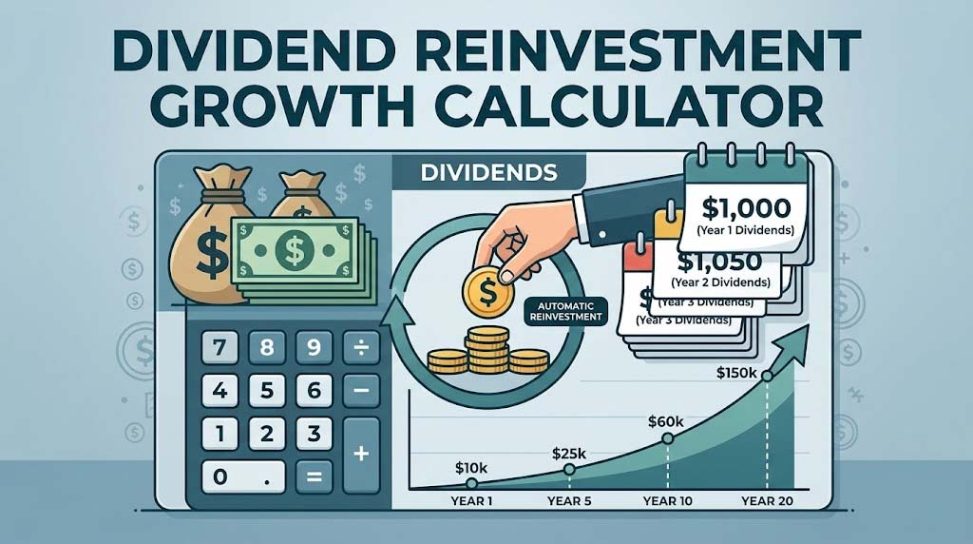
Building long-term wealth often depends on more than simply earning a return on an investment. What happens to dividends after they are received can have a major impact on future growth. A Dividend Reinvestment Growth Calculator helps investors estimate how an investment could grow when dividends are regularly reinvested to purchase additional shares.
By combining dividend income with potential price appreciation and the power of compounding, investors can visualize how a portfolio may develop over many years. While calculator results are estimates rather than guarantees, they can be useful for comparing different investment strategies and setting realistic long-term goals.
Why Use a Dividend Reinvestment Growth Calculator?
- Estimate Long-Term Growth: See how an investment may develop over an extended period.
- Understand Compounding: Visualize how reinvested dividends can generate additional potential income.
- Compare Strategies: Evaluate reinvesting dividends versus taking them as cash.
- Plan Investment Goals: Estimate potential future portfolio values based on selected assumptions.
- Measure Dividend Impact: Understand how dividend yield can contribute to overall returns.
- Test Different Scenarios: Change investment amounts, growth rates, and time periods to compare outcomes.
What Is Dividend Reinvestment?
Dividend reinvestment means using dividends received from an investment to purchase additional shares or units instead of taking the dividend as cash. The additional shares can potentially generate more dividends in the future.
This process can create a compounding effect over time. The longer the investment remains invested and the more consistently dividends are reinvested, the more significant the potential effect can become.
How Dividend Compounding Works
Suppose you own shares that pay dividends. Instead of withdrawing those dividends, you use them to buy more shares. Those additional shares may then generate dividends of their own during subsequent periods.
This creates a cycle where investment income can contribute to purchasing additional investments. Over a long period, even relatively small reinvestments may become meaningful when combined with continued growth.
Key Inputs in a Dividend Growth Calculator
| Input | What It Represents |
|---|---|
| Initial Investment | The amount invested at the beginning |
| Additional Contributions | Money added periodically to the investment |
| Dividend Yield | The estimated annual dividend relative to the investment value |
| Share Price Growth | The assumed annual change in investment value |
| Dividend Growth | The assumed rate at which dividends increase over time |
| Investment Period | The number of years the investment remains invested |
| Reinvestment | Whether dividends are used to purchase additional shares |
Dividend Yield Explained
Dividend yield is commonly used to compare the annual dividend paid by an investment with its current price. A higher dividend yield does not automatically mean a better investment because yield can change as the share price and dividend payment change.
Investors should therefore consider dividend yield together with the company’s financial condition, dividend history, valuation, growth prospects, and overall investment risk.
The Power of Compound Growth
Compounding occurs when returns generate additional returns over time. With dividend reinvestment, the dividends themselves can become part of the invested capital, potentially allowing future dividends to be earned on a larger number of shares.
Time is an important component of this process. A longer investment horizon gives compounding more opportunities to influence the portfolio’s potential growth.
Reinvesting Dividends vs Taking Cash
| Approach | Potential Advantage | Possible Limitation |
|---|---|---|
| Reinvest Dividends | Can increase the number of shares over time | Provides less immediate cash income |
| Take Dividends as Cash | Creates current income for spending or other purposes | Reduces the amount automatically reinvested |
| Partial Reinvestment | Balances income and continued investment | Requires more active management |
Initial Investment and Regular Contributions
The starting investment is only one part of a long-term wealth-building strategy. Regular contributions can also have a substantial effect on the potential future value of a portfolio.
For example, an investor who contributes a fixed amount every month can potentially build a much larger investment base over time than someone who makes only an initial deposit. A calculator can help illustrate how different contribution levels may affect future results.
Dividend Growth Matters
A company’s dividend payment may increase, decrease, or remain unchanged. When calculating potential long-term growth, assuming that dividends will always rise at a fixed rate can produce unrealistic results.
For this reason, it is useful to test conservative, moderate, and optimistic assumptions instead of relying on a single projection.
Why Time Is So Important
Dividend reinvestment generally works best as a long-term strategy because compounding needs time to develop. A portfolio that compounds for 20 or 30 years can have a very different projected outcome from one that compounds for only five years.
This does not mean longer investment periods guarantee higher returns. Markets fluctuate, companies can reduce dividends, and investment values can fall.
Understanding Total Return
Dividend income is only one component of investment performance. Total return can include both changes in the investment’s market value and income received from dividends.
For a more complete evaluation, investors should consider the combined effect of income and price movement rather than focusing only on the dividend yield.
Tax Considerations
Taxes can affect the actual return an investor receives from dividends and capital gains. The tax treatment can vary depending on the country, account type, investment, and individual circumstances.
When using a dividend calculator, remember that a simple projection may show pre-tax growth. Investors should consider applicable tax rules when estimating their actual after-tax results.
Using a Calculator for Scenario Planning
The main value of a dividend reinvestment calculator is the ability to test different assumptions. You can compare what might happen if you increase your monthly contribution, change the investment period, adjust the expected dividend yield, or stop reinvesting dividends.
This type of scenario analysis can make long-term financial planning easier because it transforms abstract percentages into understandable numbers.
Dividend Reinvestment and Risk
Reinvesting dividends does not eliminate investment risk. The value of shares can decline, dividend payments can be reduced, and a company can suspend its dividend entirely.
Diversification can help reduce the impact of relying too heavily on a single company or asset. Investors should consider their risk tolerance and financial objectives before selecting investments.
Useful Calculators for Broader Financial Planning
Investment decisions are often connected to everyday financial expenses. For example, transportation costs can influence how much money a household has available for saving and investing. A Vehicle Trip Cost Calculator can help estimate the cost of a journey and provide a clearer picture of transportation expenses.
Similarly, personal planning often involves understanding different types of numbers and measurements. A TSH Thyroid Level Calculator is an example of a specialized calculator designed for a completely different purpose. Each calculator is most useful when its results are understood within the appropriate context.
Dividend Investing and Financial Planning
Dividend investing can be one component of a broader investment strategy. Some investors prioritize income, while others focus more heavily on long-term capital appreciation.
Before choosing a dividend-focused approach, it can be helpful to consider your investment horizon, income requirements, diversification, risk tolerance, and other financial objectives. Educational resources about dividend reinvestment plans can also help explain how automatic dividend reinvestment works.
Common Mistakes When Estimating Dividend Growth
- Assuming dividend payments will increase every year without interruption.
- Using an unrealistically high annual return for a long-term projection.
- Ignoring taxes, fees, and investment expenses.
- Focusing only on dividend yield instead of total return.
- Assuming past dividend growth guarantees future results.
- Ignoring the possibility of share price declines.
- Relying on one projection instead of comparing multiple scenarios.
How to Use a Dividend Reinvestment Growth Calculator
- Enter the initial amount you plan to invest.
- Add any expected regular contributions.
- Enter an estimated dividend yield.
- Enter an expected dividend growth rate if applicable.
- Enter an estimated annual investment growth rate.
- Select the investment period.
- Choose whether dividends are reinvested.
- Review the projected portfolio value and potential dividend income.
- Repeat the calculation using different assumptions.
- Compare the scenarios before making an investment decision.
Why Conservative Assumptions Are Useful
Financial projections are only as reliable as their assumptions. If a calculator assumes unusually high dividend growth and investment returns, the projected result may look impressive but may not represent a realistic expectation.
Using several scenarios can provide a more balanced perspective. A conservative estimate, a middle estimate, and an optimistic estimate can show how sensitive the result is to changing assumptions.
Dividend Reinvestment for Long-Term Goals
Reinvested dividends may be particularly relevant for investors with long-term objectives such as retirement planning, wealth accumulation, or creating a future income stream. The strategy can help keep investment income working within the portfolio rather than immediately removing it.
However, investment goals differ from person to person. Someone approaching retirement may have different priorities from a younger investor with several decades before needing the money.
Keeping Track of Your Investment
A calculator provides a projection, but actual portfolio performance should be monitored over time. Keep records of contributions, dividends received, reinvestments, fees, and changes in investment value.
Regularly reviewing your portfolio can also help you determine whether your investments remain aligned with your financial goals and risk tolerance.
Understanding Financial Calculations
Calculators can make complex calculations easier, but they should not replace careful financial research. The Investor.gov guide to stocks provides educational information that can help investors understand basic concepts related to stock investing and potential risks.
Using educational resources alongside calculators can help you interpret projections more responsibly and avoid treating estimated future values as guaranteed outcomes.
Another Example of Specialized Calculators
Different calculators solve different practical problems. Someone working with handmade products may need to estimate material requirements before pricing a product. A Crochet Yarn Yardage Calculator can help estimate yarn requirements for a crochet project.
Although this has nothing to do with investment growth, it demonstrates the usefulness of calculation tools for turning inputs into practical estimates that can support better planning.
Benefits and Limitations at a Glance
| Benefits | Limitations |
|---|---|
| Illustrates the effect of dividend reinvestment | Future returns cannot be guaranteed |
| Helps visualize compound growth | Dividend payments can change |
| Allows comparison of investment scenarios | Taxes and fees may not be fully reflected |
| Supports long-term planning | Market conditions can differ from assumptions |
| Easy way to test different contribution levels | Results depend on the accuracy of the inputs |
Final Thoughts
A Dividend Reinvestment Growth Calculator can be a valuable tool for understanding how initial investments, regular contributions, dividend yields, dividend growth, and reinvestment may influence long-term portfolio growth. It makes the concept of compounding easier to visualize and can help investors compare different scenarios.
At the same time, calculator results are projections rather than promises. Dividend payments, share prices, taxes, fees, and market conditions can all change over time. The best approach is to use the calculator as one part of a broader financial planning process and combine its estimates with careful research, diversification, and realistic assumptions.
Leave a Reply