







Loading tools... Please wait.
Design Template Letter Head Format Editable
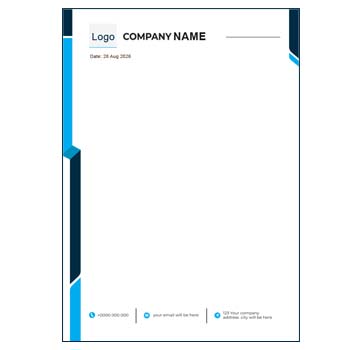
A well-designed letterhead gives business documents a recognizable and professional appearance. It combines important company information with visual elements such as a logo, typography, colors, and structured spacing.
A Design Template Letter Head Format Editable can make this process easier by providing a ready-made layout that can be personalized. Users can replace sample information with their own company details and create stationery suitable for everyday professional communication.
What Makes a Letterhead Useful?
A letterhead does more than decorate the top of a page. It identifies the organization sending the document and can provide essential contact information to the recipient.
A consistent letterhead can also help maintain the same visual identity across official letters, proposals, notices, reports, and other business documents.
Typical Elements
- Company or organization name
- Logo
- Address
- Phone number
- Email address
- Website
- Social media information
- Header design
- Footer information
- Document writing area
Editable Design Options
The exact editing features depend on the template format. Some designs allow users to change only text and images, while others may provide control over colors, shapes, typography, and layout elements.
Before selecting a template, consider how much customization you actually need.
| Element | Common Editing Requirement |
|---|---|
| Company name | ✓ |
| Logo | ✓ |
| Contact details | ✓ |
| Address | ✓ |
| Website | ✓ |
| Colors | Optional |
| Fonts | Optional |
| Header graphics | Optional |
| Footer | Optional |
| Main content area | ✓ |
Advantages and Limitations
| Advantages | Limitations |
|---|---|
| ✓ Provides a ready-made layout | • Editing depends on file format |
| ✓ Saves initial design time | • Some elements may be fixed |
| ✓ Can be reused | • Compatible software may be required |
| ✓ Helps maintain brand consistency | • Template style may not fit every industry |
| ✓ Suitable for office documents | • Advanced customization may take extra work |
| ✓ Easy to adapt for different users | • Printing requirements may vary |
Start With Your Company Information
The first stage of customization is replacing all placeholder information. Add the correct company name, logo, address, phone number, email, and website.
Review the information carefully before saving the final template. The letterhead will often be used for official communication, so accuracy is important.
Company Letterhead Online
If you prefer creating a letterhead through an online workflow, you can explore Make Company Letterhead Online Free.
An online approach can be convenient for users who want to work directly in a browser rather than setting up a complete design from scratch.
Keep the Logo Professional
The logo is usually one of the most recognizable elements of a company letterhead. Use a clear, high-quality version and maintain its original proportions.
Avoid making the logo unnecessarily large. It should establish identity while leaving enough room for the actual document content.
Choose Suitable Typography
A professional letterhead should be easy to read. Select fonts that remain clear in both digital documents and printed copies.
Using too many font styles can make the page look inconsistent. A simple combination of one or two complementary typefaces is often sufficient.
Match Your Brand Colors
If the template supports color editing, use your existing brand palette where possible. Matching the letterhead with your logo, website, business card, and other stationery creates a more unified appearance.
For everyday office printing, consider how much color the design uses. A visually attractive layout should also remain practical to reproduce.
Leave Enough Writing Space
One of the most important parts of a letterhead is the area where the actual message will appear. Avoid allowing the header or footer to consume too much of the page.
A balanced layout should work for both short communications and longer business letters.
Related Business Documents
A company letterhead is often used alongside invoices and other financial documents. For businesses that need a quick billing solution, Online Invoice Generator Free can be another useful resource.
For a simpler invoicing workflow, you can also explore the Simple Free Online Invoice Generator.
Keeping invoices and letterheads visually related can help create a consistent business identity.
Where Can You Use an Editable Letterhead?
A customized letterhead can be used for:
- Official business letters
- Client communication
- Company notices
- Business proposals
- Reports
- Quotations
- Partnership correspondence
- Office announcements
- Professional statements
- Administrative documents
The same master design can be reused while changing the body content for each individual document.
Digital Letterhead
Letterheads are no longer limited to printed paper. Businesses can use branded layouts when preparing PDFs and other digital documents for email or online communication.
After exporting a document, inspect the final file to make sure the logo, fonts, margins, and contact information have not shifted.
Printing the Final Design
Before printing large quantities, produce a test copy. Check the paper size, margins, colors, logo quality, and footer alignment.
If the design contains large background graphics, consider whether they are practical for regular office printing.
Build a Complete Stationery Identity
A letterhead becomes more effective when it belongs to a wider stationery system. Business cards, invoices, envelopes, forms, and other materials can use similar colors, typography, and branding.
This consistency can make the organization more recognizable and give its documents a more professional appearance.
Keep a Master Template
Once your letterhead has been customized, save a clean master version. This file should contain the approved logo, company details, colors, and layout.
For each new document, make a copy of the master file rather than modifying the original. This prevents accidental changes to the standard stationery.
Simple vs. Creative Letterhead
A corporate organization may prefer a restrained design with minimal graphics, while a creative agency or fashion business may choose a more expressive layout.
The right choice depends on the brand. The design should reflect the organization without compromising readability or practical use.
Check Before Final Use
Before distributing your letterhead, verify:
- Company name
- Logo
- Phone number
- Email address
- Website
- Office address
- Spelling
- Font consistency
- Page margins
- Header and footer spacing
- Print quality
These small checks can prevent errors from appearing on official documents.
What Is Letterhead?
Letterhead is a form of stationery used to identify the sender of written communication. It commonly includes organizational branding and contact information.
For a general reference, see Letterhead on Wikipedia.
Design Inspiration
When creating or customizing a letterhead, consider the relationship between typography, spacing, branding, and the available writing area. A good design should remain attractive without making the document difficult to use.
For additional visual references, explore Letterhead Templates on Canva.
Suitable for Different Professionals
Editable letterhead formats can be adapted for many users, including:
- Small businesses
- Corporate offices
- Freelancers
- Consultants
- Agencies
- Startups
- Educational institutions
- NGOs
- Service providers
- Creative professionals
The same basic layout can be personalized according to the organization’s industry and branding requirements.
A Practical Editing Workflow
Choose a suitable template and replace the placeholder content with your own information. Insert the correct logo, adjust colors or fonts if supported, and review the overall spacing.
Next, save the customized master version. Create a test document and export or print it to confirm that the final appearance is correct.
Final Thoughts
A Design Template Letter Head Format Editable offers a practical starting point for creating professional business stationery. Instead of spending time building every design element from scratch, you can customize an existing structure and adapt it to your brand.
Whether it is used for formal correspondence, proposals, reports, or everyday office communication, the best letterhead combines clear branding with practical usability. Keep the design clean, the information accurate, and the writing area sufficiently spacious for regular use.
Leave a Reply