
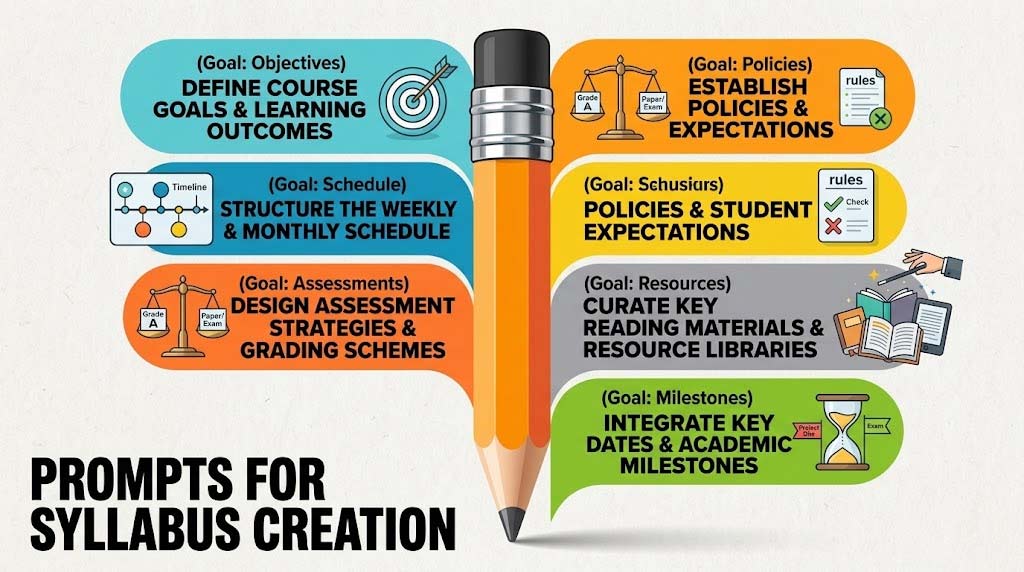
🏛️ AI Prompts for University Syllabus Creation
Configure the course level, academic discipline, and pedagogical focus to generate comprehensive, accreditation-ready course syllabi and modular plans.
27 Curriculum Design Prompts
Accelerate course development. Use these precise AI prompts to draft reading lists, map learning outcomes, and establish rigorous academic policies.
Co-Designing the Future of Higher Ed
Creating a university syllabus from scratch can take weeks of careful planning to balance reading loads, accreditation requirements, and assessment strategies. By utilizing these targeted prompts, faculty can automate the structural heavy-lifting and focus their energy on course delivery and student mentorship.
"As an adjunct professor balancing three different courses, syllabus week used to be a nightmare. Using these prompts, I was able to map out a 15-week seminar on modern economic policy in two hours. The AI suggested an incredible breakdown of formative vs. summative assessments that my department chair loved."


How to Use AI for University Syllabus Creation and Course Design
Designing a comprehensive university course is a monumental task. Professors must balance rigorous academic standards with engaging pedagogy, all while ensuring compliance with departmental and accreditation requirements. Today, Artificial Intelligence tools like ChatGPT and Claude are serving as highly capable "Curriculum Co-Designers," allowing faculty to build robust, modern syllabi in a fraction of the time.
Here is how higher-education professionals can ethically and effectively leverage AI for syllabus creation.
1. Overcoming the Blank Page: The 15-Week Outline
The hardest part of course design is pacing. How do you fit an entire discipline into 15 weeks without overwhelming students? By providing an AI with your core textbook or list of primary topics, you can ask it to generate a modular timeline. Prompting the AI to "Distribute these 12 core concepts across a 15-week semester, including a midterm week, a fall break, and a final review week" provides an immediate, workable skeleton.
2. Aligning with Bloom's Taxonomy
"Accreditation boards look heavily at our learning outcomes. I use AI to translate my broad goals into specific, measurable action verbs that align perfectly with the higher tiers of Bloom's Taxonomy." — Curriculum Director
Vague objectives like "Students will understand..." are no longer acceptable in modern syllabus design. You can feed your general course goals to an AI and ask it to refine them using Bloom's Taxonomy, ensuring your syllabus promises measurable outcomes like "evaluate," "synthesize," and "design."
3. Updating Modern Academic Policies
| Syllabus Policy Section | How AI Can Assist | Key Considerations |
|---|---|---|
| AI & Generative Tech Use | Drafting a clear, tiered policy on when and how students can use ChatGPT for assignments. | Ensure it aligns with the university's overarching academic integrity code. |
| Diversity & Inclusion (DEI) | Generating a welcoming statement that acknowledges diverse learning backgrounds. | Customize the AI's draft to reflect your personal teaching philosophy. |
| Mental Health Resources | Structuring a compassionate section directing students to campus support. | Always manually insert the correct local campus phone numbers and links. |
| Late Work & Extensions | Drafting clear, unambiguous boundaries regarding deadlines and penalties. | Keep the tone firm but supportive. |
4. Balancing Assessment Types
A modern syllabus moves away from relying solely on two massive exams. You can use AI to brainstorm a balance of formative assessments (low-stakes weekly quizzes, discussion boards) and summative assessments (term papers, capstone projects). Ask the AI to: "Design a grading breakdown where 40% of the grade is based on low-stakes, active-learning tasks."
5. The Ethical AI Curriculum Designer
While AI is phenomenal at structuring content and drafting policies, the intellectual heart of the course must come from the professor. AI can suggest reading materials, but it is prone to hallucinating citations or suggesting outdated texts. Always verify the reading list, and use AI to organize your expertise rather than replace it. The syllabus is a contract between you and your students; AI just helps you write it faster.