









Loading tools... Please wait.
ChatGPT for Beginners Course with Certificate
ChatGPT has become one of the most popular Artificial Intelligence tools for learning, writing, research, communication, productivity, and creative work. However, beginners often need proper guidance to understand how to use ChatGPT effectively instead of simply asking random questions and expecting perfect results.
A ChatGPT for Beginners Course with Certificate can provide a practical introduction to ChatGPT and help learners understand how to create better prompts, generate useful content, improve productivity, and use AI responsibly. With structured learning and hands-on practice, beginners can gradually develop the confidence to use ChatGPT for education, professional work, business, and everyday tasks.
What You Can Learn
- ChatGPT Fundamentals: Understand what ChatGPT is and how it works.
- Prompt Writing: Learn how to give clear and effective instructions.
- Content Creation: Use ChatGPT for writing, editing, and brainstorming.
- Learning Support: Use AI to understand subjects and practice new skills.
- Workplace Productivity: Create emails, reports, ideas, and professional documents.
- AI-Assisted Research: Learn how to organize information and explore topics efficiently.
- Certificate: Complete the course and demonstrate your newly developed AI skills.
1. What Is ChatGPT?
ChatGPT is an AI-powered conversational system designed to understand natural-language instructions and generate responses. It can assist users with a wide range of tasks, including writing, explaining concepts, brainstorming, summarizing, planning, and many other forms of digital work.
For beginners, the most important concept is that ChatGPT works through interaction. Users provide instructions, review the response, and can continue the conversation to improve or modify the result.
2. Why Learn ChatGPT as a Beginner?
AI is becoming increasingly common in education, offices, businesses, marketing, freelancing, and content creation. Learning how to use ChatGPT effectively can therefore become a useful digital skill for people from many different backgrounds.
Instead of spending excessive time on repetitive tasks, users can use ChatGPT as an assistant for drafting, organizing ideas, preparing content, and exploring solutions.
3. Understanding the ChatGPT Interface
Before learning advanced techniques, beginners should become familiar with the basic ChatGPT interface. Understanding how to start a conversation, enter instructions, continue a discussion, and refine previous answers provides the foundation for more productive AI usage.
Once the basic interface becomes familiar, learners can gradually experiment with more structured prompts and practical workflows.
4. What Is a Prompt?
A prompt is the instruction or request that a user gives to an AI system. It can be a question, command, description, or detailed set of instructions.
For example, instead of simply asking “Write an email,” a user could explain the purpose of the email, the recipient’s role, the desired tone, and the information that must be included.
The more clearly the user communicates the objective, the easier it becomes to guide the AI toward a useful result.
5. Simple Prompt vs. Effective Prompt
One of the first lessons beginners should understand is the difference between a basic prompt and a well-structured prompt.
Basic prompt: “Write a business email.”
Improved prompt: “Write a short and professional email to a client explaining that the project delivery will be delayed by two days. Use a polite and reassuring tone.”
The second instruction provides context, purpose, tone, and a specific objective, allowing ChatGPT to produce a more appropriate response.
6. ChatGPT for Office Work
ChatGPT can be useful for many everyday office activities. Professionals can use it to prepare email drafts, organize meeting notes, create checklists, develop report structures, brainstorm ideas, and improve written communication.
It can also help users rewrite complicated information into simpler language or adjust the tone of a message for different professional situations.
7. ChatGPT and Professional Etiquette
Using AI effectively in the workplace also requires an understanding of professional communication. ChatGPT can help users draft polite messages, organize business communication, and practice different workplace scenarios.
Professionals who want to strengthen their workplace communication can also explore an Office Etiquette Course to develop broader professional etiquette skills.
8. ChatGPT for Education
Students can use ChatGPT as a learning assistant for explanations, brainstorming, practice questions, language exercises, study planning, and revision.
For example, a learner can ask ChatGPT to explain a difficult concept using simple language and then request examples or practice questions. This can make self-learning more interactive and accessible.
Language learners preparing for international examinations may also combine AI-based practice with structured resources such as an IELTS Exam Preparation Course.
9. ChatGPT for Creative Learning
AI can also support creative learners by helping them brainstorm ideas, develop concepts, create project outlines, and explore different approaches to creative work.
However, AI should complement rather than completely replace personal creativity and practical skills. Someone learning traditional visual techniques, for example, can continue practicing independently while using AI for inspiration and idea development.
Beginners interested in traditional creative skills may explore Pencil Drawing Classes alongside their digital learning journey.
10. ChatGPT for Content Creation
Content creators can use ChatGPT to brainstorm topics, create outlines, rewrite paragraphs, develop social media ideas, prepare scripts, and improve readability.
The best results usually come when the user provides information about the target audience, content purpose, preferred tone, word count, and required structure.
Human editing remains important because AI-generated content may require fact-checking, personalization, and refinement before publication.
11. ChatGPT for Business and Freelancing
Freelancers and small business owners can use ChatGPT for many practical activities. It can assist with proposal ideas, service descriptions, customer communication, marketing concepts, content planning, and workflow organization.
For freelancers, learning how to communicate effectively with AI can also improve productivity when handling repetitive tasks. Instead of starting every task from scratch, users can develop reusable prompts and templates.
12. Useful ChatGPT Prompt Techniques
Beginners can improve their results by following several simple prompting techniques.
Give Clear Instructions
Explain exactly what you want ChatGPT to do rather than using a vague request.
Provide Context
Include relevant information about the project, audience, business, or situation.
Specify the Format
Tell ChatGPT whether you want a table, bullet list, article, email, checklist, or another format.
Set the Tone
Specify whether the response should be professional, friendly, formal, persuasive, simple, or conversational.
Refine the Result
If the first answer is not suitable, provide additional instructions and ask ChatGPT to improve it.
13. Advantages and Limitations of Learning ChatGPT
| Advantages | Limitations |
|---|---|
| Can save time on repetitive tasks | AI-generated information may sometimes be inaccurate |
| Useful for writing and brainstorming | Important information should be verified |
| Can support education and self-learning | AI should not replace critical thinking |
| Helpful for professional communication | Results depend on the quality of instructions |
| Accessible to beginners | Some features may depend on the available plan or service |
| Can improve productivity | Privacy should be considered when sharing information |
14. Common Mistakes Beginners Make
New users often expect ChatGPT to understand exactly what they want without providing enough information. This can lead to generic, incomplete, or unsuitable responses.
Another common mistake is accepting every AI-generated answer without checking it. ChatGPT can be extremely useful, but users should review important facts, especially when the information affects academic, professional, financial, legal, or other significant decisions.
15. Building Your Own Prompt Library
A personal prompt library can make ChatGPT much more useful over time. Users can save prompts that work well for tasks they perform regularly.
For example, a user might maintain separate prompts for professional emails, social media posts, content outlines, research assistance, customer responses, study planning, and business tasks.
These reusable prompts can then be modified whenever a similar task appears.
16. ChatGPT for Everyday Productivity
ChatGPT is not limited to professional tasks. It can also help users organize ideas, prepare personal plans, create learning schedules, explain unfamiliar concepts, and brainstorm solutions to everyday challenges.
The key is to treat ChatGPT as an assistant rather than an unquestionable authority. Users should remain responsible for reviewing and making decisions based on the generated information.
17. Responsible and Safe Use of ChatGPT
Responsible AI use is an important part of becoming a confident ChatGPT user. Avoid sharing confidential, private, or sensitive information unless you fully understand how the relevant service handles that information.
Users should also consider accuracy, copyright, privacy, bias, and the intended purpose of AI-generated content. Reviewing the final result before using or publishing it is an essential habit.
18. ChatGPT Skills for the Modern Workplace
As businesses increasingly adopt AI-assisted workflows, employees who understand how to communicate effectively with AI may have an advantage when completing certain digital tasks.
ChatGPT skills can be particularly useful in areas such as administration, customer service, marketing, content development, education, research, and business communication.
19. Who Should Take a ChatGPT for Beginners Course?
A beginner-level ChatGPT course can be useful for people with different professional and educational backgrounds.
- Students
- Teachers and educators
- Office professionals
- Freelancers
- Content creators
- Digital marketers
- Business owners
- Entrepreneurs
- Job seekers
- Anyone interested in Artificial Intelligence
Advanced programming knowledge is generally not required to begin learning practical ChatGPT skills. A basic understanding of computers and internet applications is enough to start experimenting with AI-assisted workflows.
20. The Value of a Course Certificate
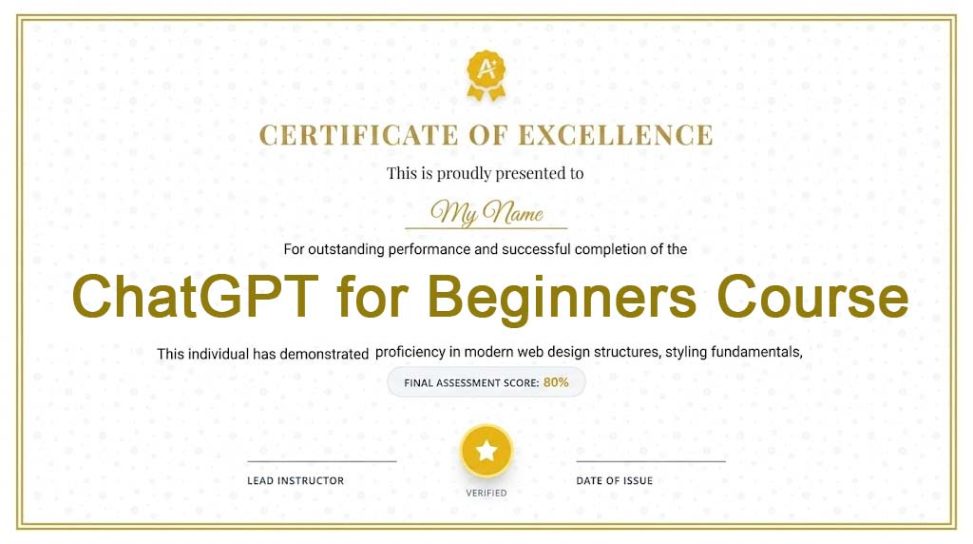
A course certificate can provide evidence that a learner has completed a structured training program. It can be useful when documenting professional development, adding learning achievements to a portfolio, or demonstrating commitment to acquiring new digital skills.
However, a certificate is most valuable when supported by practical knowledge. Learners should focus on developing real ChatGPT skills rather than collecting certificates alone.
21. How to Continue Learning After the Course
AI technology continues to evolve, so learning should not stop after completing an introductory course. Regular practice is one of the best ways to improve.
Try different prompt structures, test ChatGPT with real-world tasks, compare different approaches, and gradually build workflows that fit your personal or professional needs.
22. Final Checklist for New ChatGPT Users
- Understand the basic ChatGPT interface.
- Learn how to write clear prompts.
- Provide enough context for important tasks.
- Specify the desired output format.
- Use follow-up prompts to improve results.
- Build a personal library of useful prompts.
- Fact-check important information.
- Protect confidential and sensitive information.
- Use AI to support rather than replace human judgment.
- Continue practicing with real-world tasks.
23. Final Thoughts
A ChatGPT for Beginners Course with Certificate can provide a strong foundation for people who want to understand and use AI in their daily lives. From writing and education to office productivity, freelancing, marketing, and creative work, ChatGPT can support a wide range of activities when used correctly.
The most important skill is not simply knowing how to ask ChatGPT a question. It is learning how to communicate clearly, provide context, evaluate the response, refine the instructions, and apply the final result responsibly.
With consistent practice and a practical learning approach, beginners can turn ChatGPT from a simple conversational tool into a valuable digital assistant for learning, productivity, and professional development.
Leave a Reply