






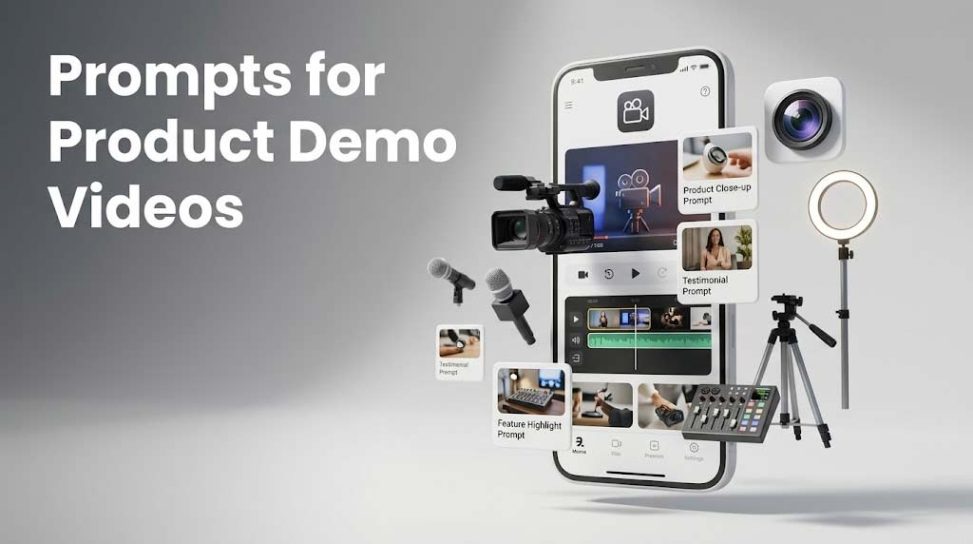
🚀 AI Prompts for Product Demo Videos
Generate high-converting video scripts and storyboards. Configure your product type, target audience, and marketing goal to create professional demos that drive sales.
27 Essential Product Demo Prompts
From sleek SaaS walkthroughs to cinematic hardware reveals. Use these templates to draft commercial-grade scripts that showcase your product's true value.
Converting Viewers into Users
A great product demo doesn't just list features; it tells a story of transformation. Whether you are launching a new high-speed internet package or a complex AI prompt tool, the script must focus on how the product makes the user's life easier, faster, or better.
"We were struggling to explain our new B2B software update without sounding like a boring manual. I used the 'Pain-Agitate-Solve' prompt here, and the AI structured a script that perfectly balanced screen recordings with a compelling narrative. Our sign-up conversion rate from that video jumped by 30%."

How to Script High-Converting Product Demo Videos using AI
Creating a product demo video is one of the most critical steps in any digital marketing strategy. Whether you are promoting a new physical tech gadget, a high-speed ISP connection, or a SaaS dashboard, your video is often the first interaction a customer has with your interface. If the video is confusing, boring, or too focused on technical jargon, you will lose the sale. By utilizing AI to structure your scripts, you can guarantee a commercial that focuses on the user's pain points and the product's solutions.
Here is how to prompt AI to build the perfect product demo.
1. The "Pain-Agitate-Solve" Framework
The biggest mistake marketers make is starting a demo video by showing the product. Instead, you must start with the problem. You can prompt ChatGPT using the PAS framework: "Write a 60-second video script using the Pain-Agitate-Solve method. Identify the pain of slow internet, agitate the frustration of buffering during movie night, and introduce our new Gigabit connection as the ultimate solution."
2. Visuals: SaaS vs. Physical Products
"For software, the screen is the star. Don't let a talking head distract from the UI. For physical products, lighting and motion are everything." — Video Production Director
When asking AI to write your script, demand a two-column format (Audio vs. Video). If it is a SaaS product, prompt the AI to include specific cursor movements: "Describe exactly where the mouse clicks and how the dashboard zooms in on the analytics chart." If it is physical hardware, prompt for cinematography: "Describe the lighting and camera pan across the sleek aluminum chassis."
3. AI Storyboarding & Pacing Guide
| Video Segment | Timeframe | Objective |
|---|---|---|
| The Hook (The Pain) | 0:00 - 0:05 | Address the exact problem the target audience is facing right now. |
| The Reveal (The Hero) | 0:05 - 0:15 | Introduce the product name, logo, and a beautiful wide shot of the interface/item. |
| The "Aha!" Moment (Demo) | 0:15 - 0:45 | Show the top 3 features in action. Focus on *speed* and *ease of use*. |
| The Call to Action (CTA) | 0:45 - 0:60 | Tell them exactly what to do next (e.g., "Start your free trial today at..."). |
4. Translating Features into Benefits
Users don't care about "256-bit encryption" or "AI-driven algorithms." They care about "your data is safe" and "it saves you 3 hours a day." You can feed your technical spec sheet to ChatGPT and prompt: "Take this list of technical features and translate each one into a human-centric benefit for a B2B audience. Use these benefits as the core voiceover script."
5. The Cinematic "Apple-Style" Reveal
If you are launching a flagship product, you want it to feel premium. Apple's marketing is legendary for its minimalism and focus on design. Prompt AI to mimic this: "Write a 30-second teaser script in the style of an Apple product launch. Use short, punchy sentences, lots of negative space, slow-panning macro shots, and focus entirely on the sleek design and feeling of the product rather than the specs."
Leave a Reply